
Laser Hardening for High-Wear Industrial Parts
Laser hardening increases wear resistance with minimal deformation through precise laser heating and self-quenching. Ideal for gears, shafts, rails and tooling.
Request a Process Assessment →What Is Laser Hardening?
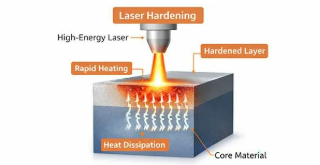
A surface heat treatment process where a high-energy laser rapidly heats the material surface above the austenitizing temperature. The hardened layer forms through self-quenching — as heat dissipates into the core material — without requiring water or oil cooling.
- No melting, no coating
- Processing only in the local/targeted zone
- Hardened surface + tough core
Why Choose Laser Hardening?
Laser hardening delivers consistent hardness depth without compromising dimensional accuracy.
✓Minimal deformation — ideal for precision parts
✓Selective hardening — only in the wear zone
✓Clean & eco-friendly — no coolant required
✓High repeatability — automation-ready
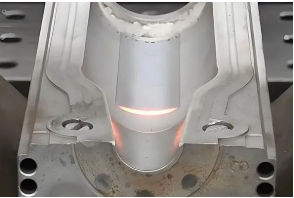
Typical Laser Hardening Applications
Gears
Wear/pitting resistance on tooth flanks and root areas, extending service life under high loads.
Hydraulic Cylinders & Piston Rods
Localized hardening to improve fatigue resistance and reduce surface wear.
Linear Guide Rails
High-hardness working surface with minimal warping, long-term precision.
Cutting Tools & Molds
Extended tool life through controlled hardening depth while preserving core toughness.
Mold & Tooling Components
Selective reinforcement of high-wear zones, reducing maintenance frequency.
Shafts, Pins & Bearing Seats
Improved wear resistance and dimensional stability in rotating/load-bearing areas.
Which Industries Use It?
Who Chooses This?
Teams responsible for production/maintenance in the sectors above typically turn to laser hardening for the following needs:
Maintenance & Reliability Engineers
Teams looking to reduce wear-related failure rates and extend maintenance intervals, particularly for parts operating under high loads.
Quality & R&D Teams
Teams working with parts where dimensional precision is critical and traditional hardening methods carry deformation risk.
Production Automation Managers
Teams wanting to integrate the hardening step into a robot/CNC line, establishing a repeatable process without coolant/waste management.
Why High-Power Diode Laser?
Designed for stable processes, easy system integration and industrial-scale production.
Stable Melt Pool
Homogeneous energy distribution ensures low dilution and a narrow heat-affected zone (HAZ).
Minimum Deformation
Controlled heat input minimizes thermal deformation on precision parts.
Modular Design
Modular laser and optics architecture simplifies system integration and maintenance.
300W – 100kW Platform
A single unified diode laser platform, from precision repair to large-area cladding.
Automation-Ready
Designed for seamless integration with robots, gantry systems and CNC machines.
When Should Laser Hardening Be Chosen?
If one or more of the following apply to you, laser hardening is technically worth evaluating.
- If dimensional precision is critical and deformation risk is unacceptable
- If only a specific/local zone needs to be hardened
- If avoiding water/oil coolant waste is desired
- If the hardening step needs to be integrated into an automation line
Recommended Systems for This Application
VIV-6000W Compact Diode Laser
A compact system with 6,000W output power, optimized for laser hardening and cladding applications. Full technical specifications are available in our product catalog.
Go to Product Catalog →Why Kuant Laser · Vivlaser
Let's Evaluate Your Hardening Needs Together
Share your part geometry, material and wear issue — our engineers will assess feasibility and recommend the right laser hardening solution for you.
Contact Us