
Laser Softening & Annealing
Laser softening is a localized heat treatment process that reduces material hardness and relieves internal stress through controlled laser heating. It improves ductility, toughness and machinability without affecting the whole part.
Let's Evaluate Your Application →What Is Laser Softening / Annealing?
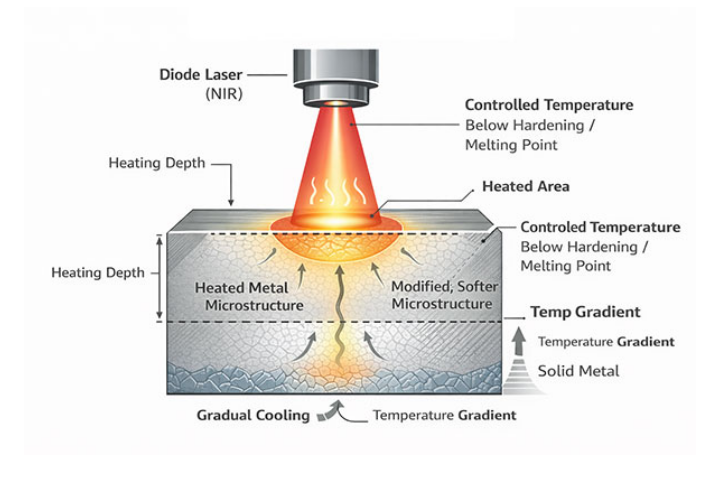
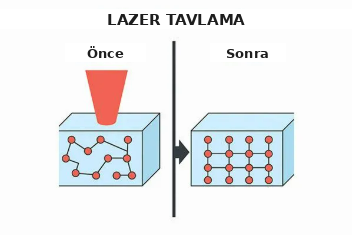
Laser softening, also known as laser tempering, is a heat treatment process in which a laser heats the material to a controlled temperature below its hardening or melting point. The process alters the microstructure, reduces hardness, and increases toughness while preserving dimensional stability.
- No melting, no coating
- Processing only in the local zone
- Hardened surface + tough core
Why Laser Instead of Conventional Heat Treatment?
✓Localized Process — Only the targeted zone is heated, surrounding material is unaffected
✓Minimal Deformation — Low overall heat input reduces warping and dimensional change
✓Process Flexibility — Suitable for selective softening on complex or assembled components
How Does Laser Softening Work?
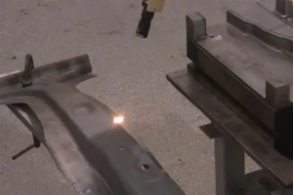
The laser beam heats the material surface to a controlled temperature range that allows microstructural transformation and stress relaxation. Heat naturally dissipates into the surrounding material, providing controlled cooling without quenching.
- No melting, no material loss
- Controlled temperature and heating depth
- Repeatable, programmable process
Typical Softening & Annealing Applications
Mold & Die Adjustment
Post-Weld/Cladding Stress Relief
Selective Softening for Machining Zones
Residual Stress Reduction
Increased Toughness & Ductility
Preparation for Secondary Processes
Which Industries Use It?
Who Chooses This?
Teams responsible for production/process operations in the sectors above typically turn to laser softening for the following needs:
Mold & Tooling Engineers
Teams needing local adjustment or correction on hardened mold/die surfaces without re-heat-treating the entire part.
Post-Weld/Cladding Process Managers
Quality and production teams wanting to relieve internal stress from welding or cladding without deforming the part.
Machining Engineers
Teams needing selective pre-machining softening on hardened zones, aiming to improve tool life and machinability.
Why Diode Laser for Softening & Annealing?
Homogeneous Energy Distribution
A flat-top beam profile provides controlled heating without overheating or hot-spot formation.
Precise Thermal Control
Adjustable beam size and power enable precise temperature management.
Contactless Process
No mechanical load — ideal for delicate and thin-walled components.
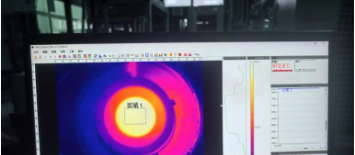
Thermal camera measurement: the controlled heating zone and temperature distribution are monitored in real time.
When Should Laser Softening Be Chosen?
If one or more of the following apply to you, laser softening is technically worth evaluating.
- When localized hardness reduction is required
- When stress relief is needed without re-heating the entire part
- When dimensional precision must be preserved
- When selective machinability improvement is required
Recommended Systems for This Application
VIV-6000W Compact Diode Laser
A compact system with 6,000W output power, optimized for laser softening, annealing and hardening applications. Full technical specifications are available in our product catalog.
Go to Product Catalog →Why Kuant Laser · Vivlaser
Let's Evaluate Your Softening Needs Together
Share your part geometry, material and process goal — our engineers will assess feasibility and recommend the right laser softening solution for you.
Contact Us