
Laser Cladding with High-Power Diode Lasers
Dense, low-dilution metallurgical coatings for wear, corrosion and high-temperature protection. Stable melt pool with a 95% uniform top-hat beam profile, low operating cost with 50–60% electro-optical efficiency.
Request a Process Assessment →What Is Laser Cladding?
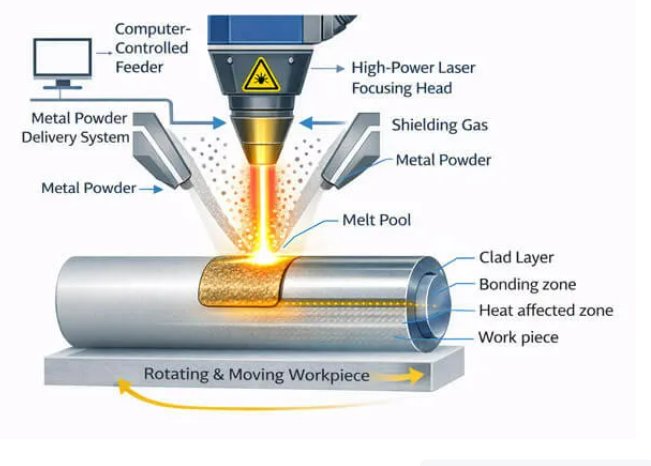
Laser cladding (Laser Metal Deposition — LMD) is a surface engineering process that creates a metallurgically bonded coating layer on a substrate using a high-power laser. Metal powder or wire is melted together with a thin surface layer of the substrate, forming a dense, low-dilution alloy layer.
Compared to thermal spray or hard chrome plating, laser cladding provides higher bond strength, lower porosity and a significantly longer service life.
- Metallurgical bond with a controlled, small melt pool
- Precise coating thickness control via powder or wire feed
- Applicable to complex geometries and graded layers
Why High-Power Diode Laser?

High Efficiency
Up to 60% electro-optical efficiency, significantly reducing energy consumption compared to fiber lasers.
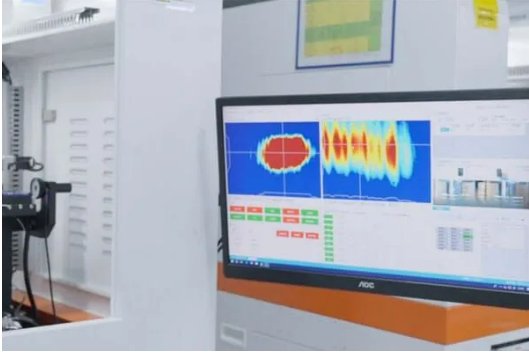
Homogeneous Energy Distribution
95% beam uniformity eliminates hot spots, stabilizes the melt pool, and reduces cracking and porosity.
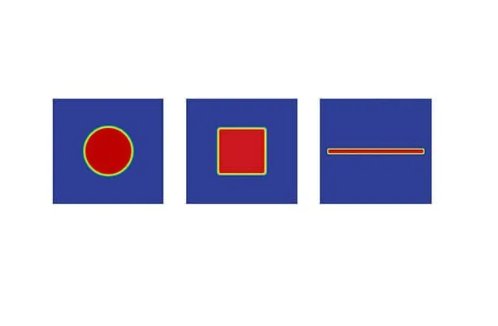
Flexible Beam Geometry
Rectangular, circular, elliptical or linear beam profiles designed to match real cladding tracks and part geometry.
Laser Cladding Process Options
Powder Laser Cladding
- Coaxial or side-feed powder delivery
- Dense coatings with controlled dilution
- Ideal for wear- and corrosion-resistant alloys
- Suitable for complex geometries and graded layers
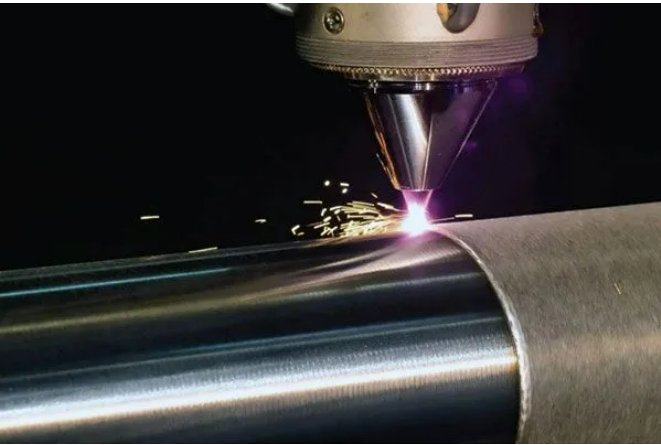
Wire & Multi-Wire Laser Cladding
- Near 100% material utilization rate
- Lower consumable material cost
- Ideal for large-area and thick-layer deposition
- Optional Hot Wire for higher efficiency and lower dilution
Laser Cladding vs. Conventional Technologies
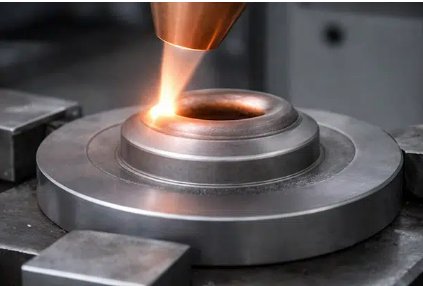
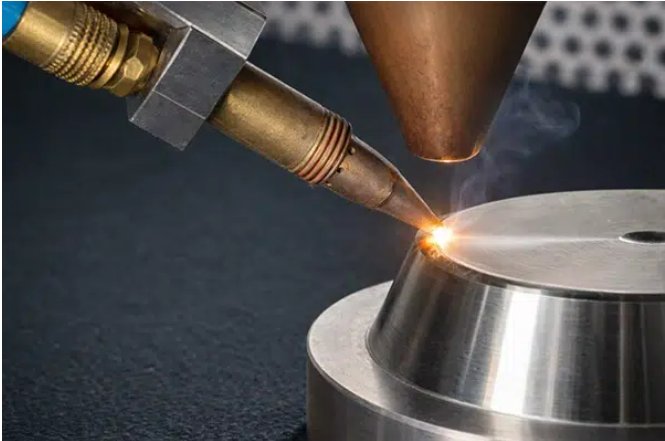
Laser Cladding
What It Is
Laser Cladding (also known as Laser Metal Deposition, LMD) is a surface engineering and additive manufacturing process that creates a new functional layer on a metal surface using a high-power laser.
How It Works
- A focused laser creates a small, controlled melt pool on the substrate
- Metal powder or wire is fed into the melt pool
- The cladding material and a thin layer of the substrate melt together
- A metallurgical bond forms between the cladding and substrate after solidification
Typical Applications
- Wear-, corrosion- and heat-resistant coatings
- Hydraulic cylinders, shafts, bearings, molds
- Brake discs, drilling tools, agricultural wear parts
- Replacing hard chrome plating and some thermal spray applications
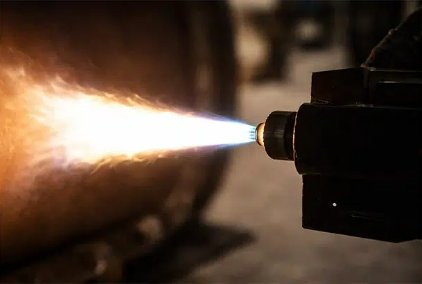
Thermal Spray
What It Is
Thermal Spray is a group of coating technologies (such as flame spray, plasma spray and HVOF) that deposit material onto a surface by spraying molten or semi-molten particles.
How It Works
- A heat source (flame, plasma or electric arc) melts the coating material
- Molten particles are accelerated toward the substrate at high speed
- Particles flatten and solidify on impact
- The coating adheres mainly through mechanical bonding, not metallurgical fusion
Typical Applications
- Large-area wear or corrosion protection
- Structural components with low thermal sensitivity
- Maintenance and repair coatings
- Cases requiring a high deposition rate
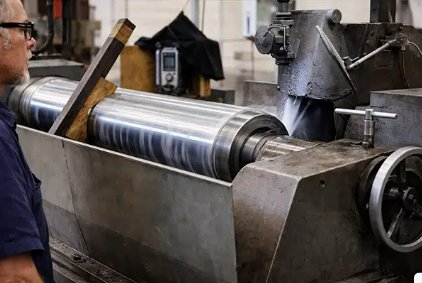
Hard Chrome Plating
What It Is
Hard Chrome Plating is an electrochemical surface process that deposits a thin chromium layer onto a metal part to increase hardness and wear resistance.
How It Works
- The workpiece is immersed in a chromium-based electrolyte
- Electric current causes chromium ions to deposit on the surface
- A thin, hard chromium layer forms
- The bond is not metallurgical and is relatively brittle
Typical Applications
- Hydraulic shafts and cylinders
- Shafts, guide columns, mold components
- Parts requiring low friction and high surface hardness
Limitations
- Uses hexavalent chromium (environmental and regulatory concerns)
- Limited coating thickness
- Risk of cracking/spalling under high load or impact
| Process | Bond | Porosity | Thickness Control | Environmental Impact |
|---|---|---|---|---|
| Laser Cladding | Metallurgical | Very Low | Excellent | Eco-friendly |
| Thermal Spray | Mechanical | Medium–High | Limited | Moderate |
| Hard Chrome Plating | Mechanical | Low | Limited | ✗ Hexavalent Chromium |
Key Advantages of Vivlaser Laser Cladding
Designed for stable processes, easy system integration and industrial-scale production.
Stable Melt Pool
Homogeneous energy distribution ensures low dilution and a narrow heat-affected zone (HAZ).
Minimum Deformation
Controlled heat input minimizes thermal deformation on precision parts; ideal for delicate components.
Modular Design
Modular laser and optics architecture simplifies system integration and long-term maintenance.
300W – 100kW Platform
A single unified diode laser platform covers all applications, from precision repair to large-area cladding.
Automation-Ready
Designed for seamless integration with robots, gantry systems and CNC machines.
Typical Laser Cladding Applications
Proven in wear-critical, corrosion-exposed and high-value industrial components.
Brake Discs & Drums
Creates dense, wear-resistant coatings on friction surfaces; significantly reduces brake wear and particulate emissions while maintaining consistent braking performance.
Hydraulic Cylinders & Piston Rods
Corrosion- and wear-resistant alloy coatings that replace hard chrome plating, extending service life under high loads and harsh environments.
Oil & Gas Drilling Tools
High-hardness, carbide-reinforced laser cladding layers protect drilling tools against extreme wear, erosion and impact in downhole environments.
Agricultural Wear Parts
Increases durability of blades, discs and soil-contact components while minimizing deformation and finishing requirements.
Bearing, Shaft & Mold Repair
Precision laser cladding enables controlled repair and surface restoration of high-value components with minimal heat input and dimensional change.
Heat Exchangers & Chemical Piping
Corrosion-resistant cladding layers protect components exposed to aggressive chemicals, high temperatures and abrasive flow conditions.
Which Industries Use It?
Who Chooses This?
Teams responsible for production/maintenance processes in the sectors above typically turn to laser cladding for the following needs:
Maintenance & Remanufacturing Teams
Teams looking to move from hard chrome plating to an eco-friendlier, more durable alternative, remanufacturing worn parts to extend service life.
Quality & R&D Teams
Teams needing dense, low-porosity, dimensionally controllable coatings, looking to overcome the limits of traditional coating methods.
Production Automation Managers
Teams wanting to integrate the cladding step into a robot/CNC line, establishing a highly repeatable, industrial-scale consistent process.
When Should Laser Cladding Be Chosen?
If one or more of the following apply to you, laser cladding is technically worth evaluating.
- If environmental/regulatory restrictions on hard chrome plating are a concern
- If a long service life is needed under high load or harsh conditions
- If dimensional precision is critical and low porosity/dilution is desired
- If the cladding step needs to be integrated into an automation line
Recommended Systems for This Application
VIV-6000W Compact Diode Laser
A compact system with 6,000W output power, optimized for laser cladding and hardening applications. Full technical specifications are available in our product catalog.
Go to Product Catalog →Why Kuant Laser · Vivlaser
Let's Evaluate Your Cladding Needs Together
Share your part geometry, material and wear/corrosion issue — our engineers will assess feasibility and recommend the right laser cladding solution for you.
Contact Us